Free Download The Seven Basic Plots: Why We Tell Stories
Hundreds of ready-books to check out are given in this site. We, as on-line library website will certainly constantly provide more recent or late upgrade of publications from lots of countries on the planet. It will lead you to relieve our way to seek for the variant sorts of publications. Without travelling, without spending much loan, and without spending much time come to be some advantages of taking books from this web site. And below, a The Seven Basic Plots: Why We Tell Stories is one of the current book is welcome.
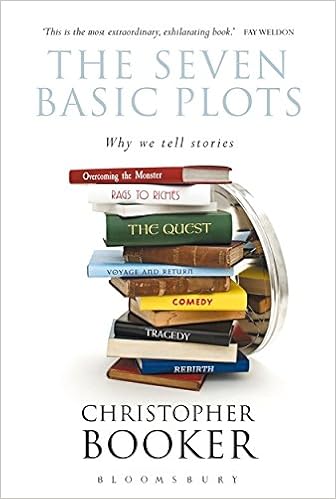
The Seven Basic Plots: Why We Tell Stories

Free Download The Seven Basic Plots: Why We Tell Stories
Show your great activity to earn your life look far better. Wait, not just look far better but exactly terrific enough! Are you believing that lots of people will be so appreciated of you who have excellent behaviors? Of course it can be among the advantages that you can get when having that type of pastimes. And also currently, just what concerning analysis? Is his your pastime? Well, checking out publication is monotonous, will you assume that so? Actually, that's not.
If you still feel perplexed to choose the book and you have no concept concerning what kind of book, you could think of The Seven Basic Plots: Why We Tell Stories Why should be it? When you are looking a book to be read, you will check out the cover style at first, will not you? It will certainly likewise be the means of you to be interested to see the title. The title of this book is likewise so interesting to review. From the title, you might be interested to review the web content.
Many individuals will certainly feel so challenging when trying to find guide from immigrant. The far range and hard area to obtain the sources come to be the huge issues to encounter. However, by seeing this website, you can find The Seven Basic Plots: Why We Tell Stories quickly. Why? We are the collection based internet that come the million titles of guides from several countries. Simply locate the search as well as discover the title. Obtain also link download when you have the book. If this book is your option, you can directly get it as your own
Linking to the net nowadays is also extremely simple and straightforward. You can do it through your hand phone or gadget or your computer system tool. To begin getting this publication, you can visit the web link in this site and obtain just what you want. This is the initiative to get this amazing The Seven Basic Plots: Why We Tell Stories You could find lots of type of book, but this incredible publication with easy way to find is very unusual. So, always remember this site to look for the other book collections.
This remarkable and monumental book at last provides a comprehensive answer to the age-old riddle of whether there are only a small number of 'basic stories' in the world. Using a wealth of examples, from ancient myths and folk tales via the plays and novels of great literature to the popular movies and TV soap operas of today, it shows that there are seven archetypal themes which recur throughout every kind of storytelling. But this is only the prelude to an investigation into how and why we are 'programmed' to imagine stories in these ways, and how they relate to the inmost patterns of human psychology. Drawing on a vast array of examples, from Proust to detective stories, from the Marquis de Sade to E.T., Christopher Booker then leads us through the extraordinary changes in the nature of storytelling over the past 200 years, and why so many stories have 'lost the plot' by losing touch with their underlying archetypal purpose.Booker analyses why evolution has given us the need to tell stories and illustrates how storytelling has provided a uniquely revealing mirror to mankind's psychological development over the past 5000 years.This seminal book opens up in an entirely new way our understanding of the real purpose storytelling plays in our lives, and will be a talking point for years to come.
Your recently viewed items and featured recommendations
›
View or edit your browsing history
After viewing product detail pages, look here to find an easy way to navigate back to pages you are interested in.
Product details
Paperback: 736 pages
Publisher: Continuum; 1 edition (September 1, 2006)
Language: English
ISBN-10: 0826480373
ISBN-13: 978-0826480378
Product Dimensions:
6.1 x 2.4 x 9 inches
Shipping Weight: 2.1 pounds (View shipping rates and policies)
Average Customer Review:
4.0 out of 5 stars
78 customer reviews
Amazon Best Sellers Rank:
#155,667 in Books (See Top 100 in Books)
The first half of this book gets 5 stars without qualification. It is a clear explanation of the archetypes that appear in the most fundamental stories, how they work together, and the ultimate purpose for telling stories. He then uses this archetypal system to analyze stories through the ages, down to very recent years. I found his analysis of Shakespeare, for instance, very helpful. This is what I bought the book for, and I am not at all disappointed.In some ways this book is not as immediately useful as, say, 'Save the Cat' and others like it are useful for screenwriting. However, I think this book delivers the groundwork for stories--the groundwork beyond which we cannot go. Its information is more fundamental than the 'Save the Cat' types. If I were a literature professor, this might well be the book I started with.As he moves into how stories have gone rogue, trying to escape from the archetypal patterns, the book begins to become repetitive, and the tone begins to change from that of confident lecturer to exasperated preacher. But these chapters are still valuable.Then he applies the archetypes to history, and things become not only repetitive, especially if you already know something about history in general and the history of religion in particular, but also without clear focus. I'm not sure he is always correct with either his facts or his analysis, although generally I consider him authoritative. It also seems to me that he is projecting the archetypes onto history, which is one of the things he warns against.Still, I find his thesis very useful, which in short is that as we lose touch with our religious ties to God, and therewith our ties to the Self (Jung), we become isolated and egotistical, on both the individual level as well as the national level. And, furthermore, that story structure can tell us how we are deficient if only we have the humility to look for it, again, both as groups, even nations, and as individuals. Ultimately these could be the most profound and important chapters of the book, but a good editor would have been useful to sort them out. For me, they were a bonus: not what I bought the book for, but a welcome introduction to the possibility of using stories to heal ourselves.
This book is actually many things:- An introduction to the seven basic plots and their many associated archetypes that work in combination.- A system. It can be applied to any story you know (and it’s fun to do so).- A tool. An almost obligatory read for anyone who invents stories. If you don’t tap on this 37 years research you’re simple on disadvantage. It’s not that everyone should follow the author's guidance in order to write stories that fulfill the self and not the ego, on the contrary, a writer might find herself not wanting to do so, but the structure the book provides is a map to decide when and how to move away or within the Self archetypical path.- A partial and moral history of literature, and an even more partial and equally moral history of Western culture.- A psychoanalis of our modern western culture, throughout the stories we invent and the ones we tell ourselves. And it's, indeed, a moralistic analysis, something that can pull the nerves of a grownup reader.- A compendium of great and diverse stories.- A source of unexpected spoilers (if you read the book be very careful with this, for it reveals the plot of so many stories and books, that chances are it will spoil something you want to read. I had to overlook several paragraphs when reading).The Odyssey versus Ulysses, E.T. versus Encounters of the Third Type, Terminator versus Frankenstein… in each comparison the author prefers the first and rejects the second option. Interestingly, this framework (or as I called it: system) allows strange and yet consistent and justifiable comparisons, such as Jaws versus Gilgamesh (borrowing a famous gedankenexperiment from Chomsky, if someone told these two stories to a martian, it will think they are just two slightly different versions of the same). It’s refreshing to see how the author jumps without loss of continuity from Hollywood B movies to universal classics. And this tool's lack of respect for the boundaries between high and low cultures (the below-the-line and the above-the-line archetype), which is itself a moral construct, compensates, in my opinion, its otherwise unbearable moralism regarding other aspects (ego versus self).In summary: vaccinate yourself against moralism, enjoy this awesome construction and the many stories it contains, be aware of spoilers, and use what you learned to write great new stories.
This is an incredibly fascinating book. As an English major in my former life (i.e. 40 years ago), I was intrigued by the seven basic plots that drive most stories, whether those stories are told in books or movies. It is simply a delight to see how the books I have read and loved fit into these seven categories. In addition to explaining and illustrating these categories, Booker gives an interesting overview of the historical development of comedy and shows how literature in the twentieth century developed in response to world events (i.e. WWII) and the cultural movements. One of the take-aways I particularly loved was Booker's explanation of why happy endings (a man and woman happily in love after overcoming great obstacles) is so satisfying and ubiquitous. Booker writes: “No idea is more central to storytelling, as we have seen, than that of one generation succeeding to another, and of the need for the hero to reach true maturity so that this can be achieved in the right way.†This is a long book (750 pages) but it is well worth a thoughtful read.
The Seven Basic Plots: Why We Tell Stories PDF
The Seven Basic Plots: Why We Tell Stories EPub
The Seven Basic Plots: Why We Tell Stories Doc
The Seven Basic Plots: Why We Tell Stories iBooks
The Seven Basic Plots: Why We Tell Stories rtf
The Seven Basic Plots: Why We Tell Stories Mobipocket
The Seven Basic Plots: Why We Tell Stories Kindle