Ebook Free Why I Write (Penguin Great Ideas)
Why I Write (Penguin Great Ideas) has the tendency to be referred book, not only by this site. Lots of people have proved that it really works to them. Just how's concerning you? As long as the topic and also problem that you ace is related to just what this book contains, it will really aid you. Fixing the troubles can be taken into consideration with lots of resources. Listening to the various other recommendations is very important. Yet, obtaining the facts and ideas from the written sources and the professional will certainly be truly finished.
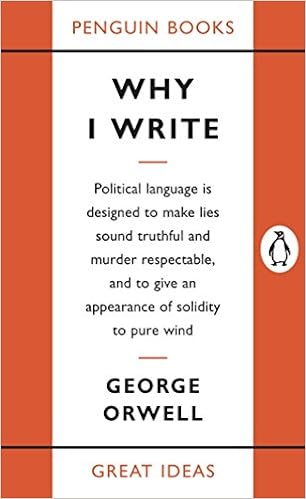
Why I Write (Penguin Great Ideas)

Ebook Free Why I Write (Penguin Great Ideas)
Why I Write (Penguin Great Ideas). It is the time to improve as well as freshen your skill, knowledge and also experience consisted of some enjoyment for you after very long time with monotone points. Operating in the workplace, visiting examine, picking up from exam as well as more tasks may be completed as well as you have to start new things. If you feel so tired, why don't you attempt new point? A very simple thing? Reading Why I Write (Penguin Great Ideas) is just what our company offer to you will know. And also guide with the title Why I Write (Penguin Great Ideas) is the recommendation currently.
This letter could not affect you to be smarter, but the book Why I Write (Penguin Great Ideas) that we offer will evoke you to be smarter. Yeah, at least you'll understand more than others who do not. This is exactly what called as the high quality life improvisation. Why must this Why I Write (Penguin Great Ideas) It's considering that this is your preferred theme to read. If you similar to this Why I Write (Penguin Great Ideas) theme about, why do not you read guide Why I Write (Penguin Great Ideas) to enrich your discussion?
This is the inspiring book that is composed by not only good however likewise outstanding writer. We offer guide because we know that you are looking for this data and book simultaneously. Gathering even more information to enhance your skill as well as experience will certainly be so easy. Reading this book by couple of could provide you the very best thing to check out. Even Why I Write (Penguin Great Ideas) is not type of your favourite books, the visibility of this book in web site have actually attracted you to be in.
Interested in this book is must. You might be other individuals that require the information and also information about the subject that have actually been written in this book. The Why I Write (Penguin Great Ideas) issue about the intriguing subject pertaining to the problem today. When you have decided to buy this publication, you can visit the link below. It will directly worry you to gain guide as yours. And also the soft data is what you could give to you. Let's obtain the book and review it currently.
A selection of George Orwell's politically charged essays on language and writing that give context to his dystopian classic, 1984Throughout history, some books have changed the world. They have transformed the way we see ourselves—and each other. They have inspired debate, dissent, war and revolution. They have enlightened, outraged, provoked and comforted. They have enriched lives—and destroyed them.Now, Penguin brings you the works of the great thinkers, pioneers, radicals and visionaries whose ideas shook civilization, and helped make us who we are. Penguin's Great Ideas series features twelve groundbreaking works by some of history's most prodigious thinkers, and each volume is beautifully packaged with a unique type-drive design that highlights the bookmaker's art. Offering great literature in great packages at great prices, this series is ideal for those readers who want to explore and savor the Great Ideas that have shaped the world.Whether puncturing the lies of politicians, wittily dissecting the English character or telling unpalatable truths about war, Orwell's timeless, uncompromising essays are more relevant, entertaining and essential than ever in today's era of spin.
Your recently viewed items and featured recommendations
›
View or edit your browsing history
After viewing product detail pages, look here to find an easy way to navigate back to pages you are interested in.
Product details
Series: Penguin Great Ideas
Paperback: 128 pages
Publisher: Penguin Books (September 6, 2005)
Language: English
ISBN-10: 0143036351
ISBN-13: 978-0143036357
Product Dimensions:
4.3 x 0.4 x 7.1 inches
Shipping Weight: 1.6 ounces (View shipping rates and policies)
Average Customer Review:
4.1 out of 5 stars
55 customer reviews
Amazon Best Sellers Rank:
#83,646 in Books (See Top 100 in Books)
Orwell calls his homeland, England, "the most class-ridden country under the sun. It is a land of snobbery and privilege, ruled largely by the old and silly." Although they were written right after WWII, these essays are appropriate as descriptions for contemporary America. Every bit as biting and true as his fiction (1984 and Animal Farm).
Great pocket Orwell to whip out when your friends are being obfuscating dicks.
This little book contains four essays written between 1931 and 1946. But the bulk of the book (85 of 120 pages) is taken up by one essay, "The Lion and the Unicorn: Socialism and the English Genius," written in 1940. The others are "Why I Write" (1946), "A Hanging" (1931), and "Politics and the English Language" (1946). I am not sure why these four essays are joined in this one volume or why the title of the volume is the title of one of the short essays. All of the essays are about politics in one way or another, but only the first and last deal with the profession of being a writer. Also, there is no introduction by an editor that might explain this collection.In spite of this mystery, the book is a good introduction to Orwell, the essayist. One gets a taste of him early on in 1931, during the physical and psychological pounding of the Blitz (1940), and in his full maturity in 1946.In "The Hanging," the young Orwell expresses his moral revulsion at capital punishment. As a policeman in Burma, he had to watch the hanging of a Hindu man. The crime for which the man is being executed is never named. Thus, we are forced to concentrate on the act of hanging a human being, rather than the execution of a criminal. Orwell writes, "I saw the mystery, the unspeakable wrongness, of cutting a life short when it is in full tide." (p. 98)The long essay, "The Lion and the Unicorn," was written in 1940 as German planes were bombing London. This brings Orwell to reflect on patriotism and its inexplicable strength throughout Britain's highly stratified society. His essay is partly an analysis of three economic/social systems---capitalism, socialism, and fascism---in a time of war. He concludes that England will survive only if it undergoes a socialistic revolution.In "Why I Write," Orwell admits that he writes for political reasons. In fact, he believes that all good books are political. His goal is to make political writing into an art."Politics and the English Language" may be one of his most famous essays. I find it reprinted in different collections of Orwell's essays. Here he is most specific in telling us what makes writing good or bad. He lists several bad practices: dying metaphors, operators or verbal false limbs, pretentious diction, and meaningless words. But he targets lack of sincerity as the worse culprit. He calls it "the enemy of clear language." And, as in "Why I Write," he reminds us that "all issues are political issues." He concludes by helpfully providing us with these six rules:1. Never use a metaphor, simile, or other figure of speech which you are used to seeing in print.2. Never use a long word where a short one will do.3. If it is possible to cut out a word, always cut it out.4. Never use the passive where you can use the active.5. Never use a foreign phrase, a scientific word, or a jargon word if you can think of an everyday English equivalent.6. Break any of these rules sooner than say anything outright barbarous.Orwell confesses that if we look back through his essay, we can probably catch him breaking his own rules. But the point is not to be fastidious, but to work towards clarity of speech. He writes, "If you simplify your English, you are freed from the worst follies of orthodoxy."
These essays can all be found as free PDFs online. But I purchased the book to own a tangible copy for my shelf. Unfortunately the jacket was put on upside down so the book has to be read backwards and upside down. Annoying that Penguin Books has such poor quality control yet they still have the audacity to ask $11 for a 100pg pamphlet.
...it was an interesting collection of essays but the title is misleading, this is mostly an angry-old-man rant about WWII era UK, not bad, just not what I was expecting
There was so much great insight here, and most of it felt relevant to the current global climate as well. I've recommended this short little book to everyone I know.
I am making up my mind about the book.Before telling what I didn't like, here are the lines I liked:*Hitler will at any rate go down in history as the man who made the City of London laugh on the wrong side of its face.*War is the greatest of all agents of change. It speeds up all processes, wipes out minor distinctions, brings realities to the surface. Above all, war brings it home to the individual. That he is NOT altogether an individual.* England is perhaps the only great country whose intellectuals are ashamed of their own nationality.* Nations do not escape from their past merely by making a revolution.* English language becomes ugly and inaccurate because our thoughts are foolish, but the slovenliness of our language makes it easier for us to have foolish thoughts.The book is good, very good, at most of the places.But some views of George Orwell-- GEORGE ORWELL (Et tu, Brute?)-- were offensive to any Indian who has read Indian history. His opinions on India's struggle for independence (and India's future without British Colony) were not well-researched. I genuinely want to give him a benefit of doubt because I am a die-hard fan of his fictions.That said, the book is good at most of the places.
What was expected
Why I Write (Penguin Great Ideas) PDF
Why I Write (Penguin Great Ideas) EPub
Why I Write (Penguin Great Ideas) Doc
Why I Write (Penguin Great Ideas) iBooks
Why I Write (Penguin Great Ideas) rtf
Why I Write (Penguin Great Ideas) Mobipocket
Why I Write (Penguin Great Ideas) Kindle